DRAFT
Report to the
U.S. Department of Energy
Office of Fusion Energy Sciences
on
Possible Pathways for
Pursuing Burning Plasma Physics
and
Fusion Energy Development
July 17, 1998
Coordinated by C. Baker and prepared by many contributors
TABLE OF CONTENT
1.0 Introduction Page 2
1.1 Purpose and Background Page 2
1.2 Community Process Page 2
Summary Page 2
2.0 Reduced Cost ITER Integrated Step Page 10
2.1 Pathway for a Reduced Cost ITER Page 10
2.2 Rationale for Reduced Cost ITER Pathway Page 12
2.3 Technical Contributions of a Reduced Cost ITER Page 13
2.4 Fusion Development Pathway Implications
of a Reduced Cost ITER Page 16
2.5 Pros & Cons of a Reduced Cost ITER Strategy Page 17
2.6 Near Term Actions Page 18
2.7 Summary of Technical Appendices on
Reduced Cost ITER Page 18
3.0 Modular Program Pathway Page 21
3.1 Pathway Overview Page 21
3.2 Rationale for the Modular Program Strategy Page 23
3.3 Technical Contributions of the Modular Plan Page 24
3.4 Pathway Implications for the Modular Plan Option Page 36
3.5 Advantages and Concerns for the Modular Program Pathway Page 36
3.6 Near Term Actions for the Modular Strategy Page 37
4.0 Enhanced Concept Innovation Pathway Page 39
4.1 Pathway Overview Page 39
4.2 Rationale Page 41
4.3 Technical Contribution Page 42
4.4 Advantages and Concerns Page 46
4.5 Near Term Actions Page 46
POSSIBLE PATHWAYS FOR PURSUING BURNING
PLASMA PHYSICS AND FUSION ENERGY DEVELOPMENT
1.0 Introduction
1.1 Purpose and Background
This report has been prepared in response to a request from the U.S. Department of Energy's (DOE) Office of Fusion Energy Sciences (letter sent by Dr. A. Davies to Dr. C. Baker, January 28, 1998) to consider possible alternatives on reduced cost options for "next-step" devices. A central focus of next-step devices is the study of "burning" plasmas which explore the impact of substantial fusion energy production via the deuterium-tritium reaction.
An important part of the U.S. Fusion Energy Sciences Program is its participation in the International Thermonuclear Experimental Reactor (ITER) program. Taking into account the international situation and U.S. domestic issues, the ITER process is exploring reduced-cost options to the present ITER device. A Special Working Group, reporting to the ITER Council, has been formed to explore these issues on behalf of the ITER Parties, i.e. the European Union, Russian Federation, Japan and the U.S. This report, and its related activities, will aid the U.S. in the international process.
1.2 Community Process
This report is the result of a broad-based U.S. community effort to discuss, debate and work together on the crucial issues involved in considering next-step options. The main content of this report is based on three potential pathways identified at a broadly-attended community Forum for Next-Step Fusion Experiments (University of Wisconsin, Madison, April, 1998) organized principally by the University Fusion Associates and by the work of the ITER Steering CommitteeUS (ISCUS) on reduced cost ITER options. The Madison Workshop was followed by a smaller Workshop on Next-Step Options (University of California, San Diego, June, 1998) to focus on preparing this report. A broadly-announced Web Site was established to facilitate access to documents related to this process.
Summary
The mission of the Fusion Energy Sciences Program is to advance plasma science, fusion science and fusion technology - the knowledge base needed for an economically attractive fusion energy source. The policy goals that support this mission include:
A key aspect of the third goal in particular is the study of the physics of burning plasmas. (This is sometimes referred to as the "third leg" of the program). This report describes potential pathways towards this goal that have been identified within the U.S. fusion community (most notably at the Madison Forum for Next-Step Fusion Experiments, April, 1998). There is a strong linkage between this element of the program and the other "two legs" of the U.S. program, i.e., to advance plasma science and concept innovation. The pathways described herein depend directly on the continuation of a viable and strong base program with adequate resources. This base program provides the underlying science and technology critical to the development of fusion energy and the study of burning plasmas. This report is predicated on the presumption that the present base program funding level of somewhat more than $200M/yr. will be continued.
The purpose of this report is to describe pathways for the U.S. to pursue burning plasma physics and fusion energy development. The first pathway features continued participation in the ITER design effort, now focused on a reduced-cost device, "ITER-RC". This device would be designed to achieve the overall programmatic objective of the original ITER device, but with somewhat reduced baseline plasma performance goals within nominal physics assumptions and the possibility of achievement of the full ITER mission if advanced physics performance can be realized. The ITER-RC tokamak would integrate a moderate-to-high energy gain plasma with a steady-state system including superconducting magnets as wells as some nuclear technology testing. The second tokamak pathway would include two devices rather than the ITER-RC: a copper-coil device, capable of DT burning plasma experiments, and a steady-state, advanced device with superconducting coils operating predominately DD plasmas. (In previous extensive design studies, substantial effort has been devoted to the design of devices suitable for both these two pathways.) The third pathway chooses to delay the burning plasma and steady-state steps to focus resources on enhancing concept innovation to prepare for later, but hopefully more affordable steps to the burning plasma and fusion energy development stage. Besides the facilities described above, all three pathways will require, to differing degrees, additional facilities for fusion technology development, such as a point neutron source and/or a volume neutron source.
The ITER-RC pathway puts stronger emphasis on physics
and technical integration, facing many important and difficult integration
problems in the near term. The modular pathway separately addresses the
physics issues of burning plasmas and steady-state and also addresses some
issues of integration (e.g. remote maintenance in at DT environment, superconducting
coils in a tokamak magnetic environment) prior to initiating an integration
step. The ITER-RC pathway is the shortest pathway for fusion energy development
but is also the pathway which would require the largest initial funding
outlay. The separate devices in the modular approach may provide greater
flexibility for concept innovation allowing a more advanced integration
step to follow. It is important to note that both ITER-RC and the modular
pathway contribute physics and technology information to other lines. The
Enhance Concept Innovation pathway puts increased emphasis on concept improvement
in the tokamak, related concepts, and concepts more distant from the tokamak,
including inertial fusion energy (IFE) prior to initiating either the modular
pathway or the integrated machine pathway. This pathway is already a key
aspect of the base program and thus also contributes to the possibility
of pathway 1 and 2. Each of these pathways are aimed at the same long-term
goal but will arrive there with different time scales, costs and degrees
of technical challenges and risks.
The Promise of Fusion
The benefits of Fusion R&D were clearly seen by the President's Committee of Advisors on Science and Technology (PCAST) in the 1995 Report of the Fusion Review Panel. Their stated views are increasingly valid today and are quoted below.
"The principal objective of the U. S. program of fusion energy research and development is to provide this country and the world with an abundant, safe, environmentally attractive, and cost-competitive new energy source. Achieving this objective would bring large benefits almost irrespective of how the energy future unfolds; and achieving it could be crucial of society finds it necessary, for environmental or political reasons, to reduce sharply the currently dominant role of fossil fuels in world energy supply."
"In the course of pursuing this energy goal, fusion R&D yields an immediate and continuous additional benefit by nourishing an important branch of basic science - plasma physics - and the technologies related to pursuing it. This field of research, for which nearly all of the funding comes from fusion energy R&D budgets, has been prolific in the production of insights and techniques with wide applications in other fields of science and in industry."
"Finally, for a variety of reasons, fusion energy R&D has evolved a higher degree of international scientific and technological cooperation than any other field of scientific or technological research. This cooperation - entailing not only extensive exchanges of personnel and information but also full-fledged international collaboration in design, construction, and operation of some of the largest experiments - is in itself a valuable model and precedent for internationalization of R&D in other fields. Such cooperation is likely to become increasingly important as the costs of cutting-edge R&D continue to grow in relation to the capacities of individual nations to pay for it."
Progress in Fusion
The research field of Fusion Energy Science has in the last two decades made major scientific advances. Supported by large investments in the late 70's and early 80's, facilities capable of producing and sustaining plasmas with fusion relevant parameters were built and successfully operated. The science of plasma measurement techniques was developed; today nearly all quantities of relevance needed to compare to theories are measured with sufficient precision. Plasma stability limits have been explored experimentally and the results are quantitatively predicted with high accuracy. The theoretical minimum in cross-field plasma ion transport has been reached in some circumstances. Plasmas with high degrees of recombination before reaching a material surface have been produced, fulfilling the simplest vision of magnetic confinement as using the magnetic field to prevent hot plasma from touching the material wall of the confining chamber. Methods to drive the current in low-to-moderate density plasmas with auxiliary means have been successfully employed; the efficiencies of these methods are in accord with theory and code modules exist to calculate the driven currents. The theoretically predicted self-driven or bootstrap current has been confirmed and has significantly enhanced prospects for steady-state operation. The result of these advances has been a confirmation of theory in most areas and a computational basis of plasma understanding sufficient for predictive projection of the performance of next step devices. These recent advances also show the commonalty of the issues for fusion concepts (for example, various toroidal concepts) and how advances in one concept (e.g., tokamaks) can be exploited in alternate configurations.
This advance in scientific understanding was made possible by supporting advances in fusion technologies. Magnetic coil systems and their associated feedback control systems were developed to stably confine the plasma equilibrium and produce many variations of plasma shape for optimization of plasma performance. Plasma heating technologies were developed and deployed at the tens of megawatt level; these systems were indispensable in the studies of plasma stability and current drive and also now are the basis of many important plasma measurement techniques. Superconducting coils have been used in magnetic confinement systems and pulse lengths exceeding two hours have been produced, clearly showing the potential for steady-state. Tritium fueling systems were implemented and safely operated resulting in the large scale production of fusion power (11 MW in the TFTR tokamak and 16 MW in the JET tokamak) and over 1 gigaJoule of fusion energy produced.
The Stages of Fusion Development
In order to discuss the status of fusion progress and future pathways, it is useful to introduce the five stages of fusion concept development as described in the 1996 report by the Alternative Concept Panel formed from the Science Committee of the Fusion Energy Advisory Committee. There are five development phases applicable generally to all fusion concepts:
• proof of principle
• proof of performance
• fusion energy development
• fusion power plant deployment (begins with a DEMO
plant).
A proof-of-principle program has as its main goal the resolution of key scientific issues in depth and on a broad front. A proof-of-principle level program is generally implemented in intermediate sized devices which are capable of investigating a complete set of key issues in depth, of producing plasma parameters approaching reactor conditions, of achieving extensive control capability and of using a comprehensive set of diagnostics. In the United States, examples of proof-of-principle level devices are the Alcator C-Mod and DIII-D tokamaks.
The defining feature of the proof-of-performance level phase is the need for plasma parameters needed to minimize the extrapolation to the following more costly fusion energy development steps. The clear examples of devices in this class are the tokamaks JET in the EU, JT-60U in Japan, and TFTR in the U.S. The DIII-D and Alcator C-mod are sufficiently capable devices technically to make some contributions at this program level.
The fusion energy development phase is mainly defined by devices which can study deuterium-tritium burning plasmas and integrate reactor relevant technology. Another goal that often enters at this stage is steady-state operation with its associated technology implications such as plasma power exhaust and superconducting magnets. These two sets of issues and their integration cannot usually be addressed in devices associated with the proof-of-performance level research. It is a strategic issue of critical importance that the scientific issues of burning plasmas and steady-state cannot be addressed at the proof-of-principle level, but require facilities of significant scale and cost.
Role of the Base Program
The scientific and technological progress in the program cited above has been and will continue to be derived from a strong and healthy Fusion Energy Science base program. This base program encompasses the embryonic concept exploration stage up through the proof-of-principle stage. The scientific progress to date gives good confidence that many concepts can and should be brought through the proof-of-principle stage. The efforts on concept improvement are also contained in the base program. Given the large number and diversity of fusion approaches, an essential element of fusion strategy is the view that sequentially and over a period of time selected concepts may be moved up through the five development phases. Although the advances in the field cited above were primarily made using the tokamak confinement device, these general advances engender the anticipation that a similar level of scientific maturity can be realized for a number of other fusion approaches. The Base Program mission to bring a number of fusion concepts through the proof-of-principle stage is an essential and enduring fusion strategy element that will be pursued as a component of any larger strategy. Which concept will make the ultimately best fusion power system is a question that will be answered over time. The immediate strategic issues revolve around which concepts to advance in what order and at what pace.
Fusion Development Steps
Most of the scientific and technology progress cited above has centered around the tokamak concept. This concept was seen in the late 70's as the concept most likely to be capable of producing high performance plasmas. The research done with the tokamak has borne out this early view. The fusion program strategy has been to advance the tokamak through the development stages at the most rapid possible pace. In the 1970's a sufficient proof-of-principle basis was developed to motivate the construction of the proof-of-performance level tokamaks. These tokamaks have achieved performance levels that give the required confidence for the tokamak program to move on to the fusion development phase. It has been the U.S. and international view for the past decade that burning plasma physics is the next frontier of fusion plasma physics, and we should pursue this science as soon as practical in a tokamak device. The cost of the devices for the fusion development phase has motivated an examination of whether the proof-of-principle basis arrived at in the 80's could be improved upon. This new thrust, generally called the Advanced Tokamak (AT) program, represents renewed research at the proof-of-principle level aimed at finding the upper bounds to the potential of the tokamak as a magnetic confinement system.
There is a strong consensus in the international fusion scientific community that the tokamak is technically ready for the steps to burning plasma physics and steady-state operation. There are, however, a range of opinions (hence different pathways) about the most cost-effective and technically
sound approach at this time. This has led us to define three potential pathways:
2. Modular: two separate tokamak devices to demonstrate DT burning and long-pulse/steady-state operation; and
3. Enhanced Concept Innovation.
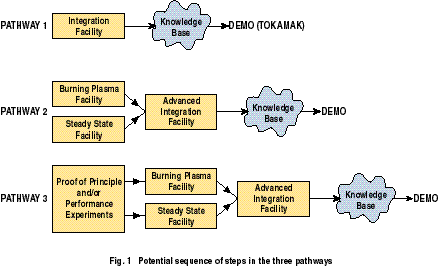
The three pathways differ in the number of remaining sequential development steps and the total time to a DEMO step, as depicted in Figure 1. Pathway 1 addresses the major physics and technology issues of fusion energy development in an integrated manner and provides the most timely pathway for the development of fusion energy to the demonstration stage. Pathway 2 addresses the major physics issues separately in less expensive devices and then addresses physics and technology integration in a subsequent advanced integration facility to arrive at the demonstration stage. Pathway 3 delays addressing the burning plasma physics and integration issues of fusion energy in the manner of either pathways 1 or 2 until other confinement concepts have been developed through the Proof-of-Principle and/or Proof-of-Performance steps. Table 1 provides a summary of the principle advantages of each pathway. The choice which is ultimately made will depend on national and international factors, as well as the technical issues outlined in this report. We have confidence, however, that whichever path is pursued, fusion can and will play an important role in the world’s energy future.
The main part of this report are the following sections which describe three pathways in detail:
1. Integrated: a single device like ITER-RC: focused on a reduced-cost version of ITER;
2. Modular: focused on separate-mission tokamak technology; and
3. Enhanced Concept Innovation: focused on concept innovation leading to the study of burning plasmas at a later time.
Each section describes the pathway and its rationale,
implications and advantages/disadvantages. Some topics, such as the potential
contribution of the Strategic Simulation Initiative and fusion Technology
and materials issues, apply to all pathways but are placed for now in the
chapter on the Modular Pathway. This report does not attempt to make value
judgments of choice among those pathways.
Table 1: Candidate Pathways - Principal Advantages
| Pathway | Advantages |
| (1) ITER-RC | Early study
of integration of burning plasmas, long-pulse/ steady-state operation and
fusion technology.
Minimizes number of steps (and time) to tokamak-based, demonstration power plant. No additional integrating facility needed. Consistent with strategic plans of ITER Partners. Makes maximum use of the leveraged U.S. investment and results of the ITER-EDA. |
| (2) Modular | Early study
of burning plasmas and long-pulse, steady-state operation.
Reduces initial facility investment costs and provides optimization for separable missions. Provides further optimization before integration step, allowing perhaps a more advanced integration step to follow. Provides multiple options for location of major facilities. |
|
|
Provides
for enhanced concept improvement leading to possibly the development of
less expensive, more attractive fusion concepts.
Reduces near-term facility investment costs. Provides further opportunities and time to optimize concept(s) for burning plasma, integration, and demonstration. Stimulates breadth of plasma science development (This is an enduring base program value common to all pathways). |
2.0 Reduced Cost ITER Integrated Step
2.1 Pathway for a Reduced Cost ITER
The "Reduced-Cost ITER" pathway exploits the existing situation in which, based on strong progress in world-wide tokamak research, the world program has decided that the tokamak concept is technically ready to proceed to a physics and technology integration step in which the next major physics issues of burning plasmas and steady-state will be explored. Implementation of the strategy requires that funding can be secured to exploit this opportunity to follow what appears to be today the most direct, economical and timely pathway for fusion energy development. The reduced-cost ITER strategy will accomplish most, perhaps all, of the ITER mission in a less costly experimental facility. The four ITER Parties have agreed to develop a reduced cost design during the EDA extension period, with the objective of reaching a construction agreement by the end of the three-year extension in July, 2001. If the reduced cost ITER is constructed, the next -step program would combine in a single major facility
• the demonstration of long-pulse advanced tokamak operating modes in burning plasmas,
• the integrated exploration of related tokamak plasma physics issues,
• the integration of fusion reactor-relevant technologies, and
• the integrated testing of fusion reactor components
in a single major facility.
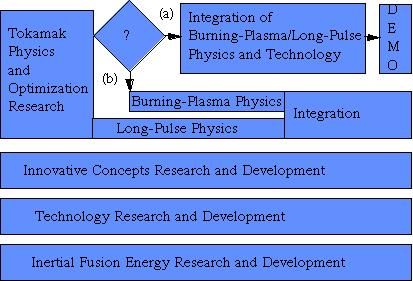

The reduced-cost ITER pathway has a high probability of sustaining the four-party ITER collaboration on a next-step tokamak. It is consistent with the collaboratively evolved strategy of the ITER project and with the fusion development strategies of our ITER partners. While the parties differ on some of the detailed specifications for the DEMO step following ITER, they envision ITER and a "point neutron source" facility (for lifetime materials testing) as providing the technical basis for the DEMO. Figure 2.1 illustrates the combination of near-term research programs feeding into the ITER step, which would lead to a tokamak DEMO when combined with the point neutron source; the base program of advanced tokamaks, other innovative concepts and technology programs would feed into the ITER and DEMO programs throughout the periods of design and operations. (Some of our ITER partners also see ITER as providing the basis for a non-tokamak DEMO, especially one using a closely-related confinement approach such as the stellarator.) The Inertial Fusion Energy Program is envisioned as progressing in parallel with the magnetic fusion energy program. Under currently limited US fusion budgets, the need to preserve a strong base program will constrain the US’s ability to contribute to ITER; however, the return on investment for the US’s contribution will be enormous due to the larger investments of the international partners.
The reduced-cost ITER will be designed with the flexibility required to accomplish a two-fold mission:
• the full ITER mission (e.g., ignition, steady-state,
Gn=
1.0 MW/m2) when operating in the enhanced physics
performance mode to demonstrate the upside potential of tokamak power systems,
but with increased technical risks.
The basic physics performance mode will use projections of the established ELMy H-mode database that are the basis for the ITER EDA design. The reduced-cost ITER will be designed to achieve the reduced mission based on ITER EDA physics rules and consequent cost/benefit design optimizations. However, the design will also include features that permit exploration of advanced tokamak (AT) modes, including shaping (k9531.6 and d9530.3, possibly within the constraint of a single null configuration), n=0 internal coils if needed for vertical position control, current profile control, flexible heating/current drive systems for pressure-profile/transport-profile control, and real-time profile diagnostics. The enhanced physics performance mode will be based on the database for advanced tokamak operation that will be established within the next few years.
It is envisioned that, during the design and construction
phases, the US would be involved in design, diagnostics, and manufacture
of high-technology tokamak components and systems, targeted at achievement
of US science and technology goals while emphasizing dual-use activities
which both benefit ITER and achieve US program goals outside ITER. In the
operations phase, the US would be involved in the scientific and technological
aspects of ITER’s experimental program, addressing the "third leg" of the
US fusion program --- the pursuit of burning plasmas and technology through
international collaboration.
2.2 Rationale for Reduced Cost ITER Pathway
The primary rationale for the reduced-cost ITER pathway is to exploit the present status of the world-wide tokamak program:
• all Parties and pathways eventually require such an integrated physics/technology step to develop fusion energy;
• the tokamak concept is technically ready to proceed with this step; and
• the cost to the Parties will be reduced if we proceed on a cost-shared international basis.
The tokamak concept is highly developed, and ongoing tokamak research is very promising with respect to future performance enhancements. The tokamak has already demonstrated reliable and sustained operation in a physics mode that extrapolates to achievement of a burning plasma in the reduced-cost ITER. The world tokamak program has achieved further enhancements in plasma performance for short periods during a pulse, and the tokamak program is presently focused on the sustainment of this enhanced performance for extended periods and on the achievement of high levels of performance in several parameters simultaneously. The reduced-cost ITER pathway will address essentially all the major next-step issues in tokamak physics and fusion technology and their integration in a single device. The reduced-cost ITER pathway will maximize use of the fusion-reactor-relevant technologies and design solutions that have been developed in the ITER EDA and will establish the knowledge base for the demonstration of fusion power in the most timely and cost effective manner.
While there are uncertainties about the levels of enhanced performance that could be achieved and sustained in the reduced-cost ITER, the design will incorporate those features that are expected to be needed to obtain optimized reactor-scale plasma performance. The planned flexibility in the design is intended to respond to the uncertainties and to provide a range of physics operating modes that will permit both broad scientific research at the forefront of tokamak plasma science and improved likelihood of mission success. The world’s tokamak research program is now focused on the resolution of high-priority physics R&D issues that relate to the design of ITER; in particular, an ITER Topical Group on Advanced Tokamaks has been established to resolve the shape issue and current-profile/pressure-profile control for the reduced-cost ITER, and there is increased attention of all Physics Expert Groups to AT needs.
2.3 Technical Contributions of a Reduced Cost ITER
As stated in the formal ITER Agreement, "The overall programmatic objective of ITER is to demonstrate the scientific and technological feasibility of fusion energy for peaceful purposes". A Special Working Group (SWG) has been charged with proposing "technical guidelines for possible changes to the current detailed technical objectives and overall technical margins, with a view to establishing options(s) of minimum cost still satisfying the overall programmatic objective of the ITER Agreement". The formal report of the SWG addressing this charge has been approved by the ITER Council. The physics benefits of the reduced-cost ITER assumes that the device would:
• aim at demonstrating steady-state operation using
non-inductive current drive with the ratio of fusion power to input power
for current drive of at least 5.
A device meeting these technical and plasma performance objectives would permit studies not only of reactor-scale burning plasma physics and long-pulse physics separately, but also their integration. While aspects of the relevant individual physics phenomena could probably be studied separately on somewhat smaller devices, the integrated combination of long pulse and reactor-scale burning plasmas together with the relevant technology is key to the mission of a device such as ITER.
2.3.1. Burning plasma physics, steady state physics, and advanced tokamak physics
Experiments in the reduced-cost ITER will explore the physics issues of "burning plasmas", in which the heating is dominated by alpha-particles created by the fusion reactions themselves, as distinct from an "ignited" ITER plasma, in which the heating is only by alpha particles. At Q=10, the power from the alpha particles would be two-thirds of the total heating power. Burning plasma physics issues will include new plasma-physical effects on the Alfvén eigenmodes made unstable by the presence within the plasma of a population of super-Alfvénic alpha particles. Although the relative population of super-Alfvénic particles is expected to be smaller than in present experiments, theoretical studies of energetic-particle modes in plasmas such as ITER’s predict that new phenomena will arise: for example, ITER-scale burning plasmas would be able to address nonlinear collective effects in which many toroidal Alfvén eigenmodes are unstable and drive fundamentally different loss mechanisms, such as stochastic diffusion due to overlapping resonances, whereas present-day (Q<1) DT plasmas can study only coherent single modes of instability and particle trapping in a resonant drift island. While detailed studies of these effects in a Q=10 (rather than ignited) ITER plasma remain to be carried out, it is clear that there will be very little difference between ignition and Q=10 in regard to the alpha particle population, so that a reduced-cost ITER plasma will be fully representative of a reactor plasma in this regard.
The reduced-cost ITER will also permit studies of the physics of very-long-pulse/steady-state plasmas, in which much of the plasma current is self-generated and which will require effective control of plasma purity and plasma-wall interactions. Achievement of a large fraction of self-generated current in a high-performance plasma will require sufficient plasma shaping, plasma stability at high normalized beta-values (or active stabilization of wall modes), and control of the profiles of quantities such as plasma current, pressure, density, and flows. The reduced-cost ITER design is aimed at incorporating increased configurational flexibility, as well as features specifically chosen so as to permit the achievement and study of steady-state operational modes. In addition, the reduced-cost ITER will address issues of steady-state control of plasma purity and plasma-wall interactions, including the physics of a "radiative divertor" designed for handling high power flow for long pulses, and would allow studies of novel plasma and atomic-physics effects, as well as advancing the materials science of surfaces subject to intense plasma interaction. Increasing triangularity of the core plasma affects the divertor magnetic configuration in a way that reduces the flexibility to accommodate uncertainties in divertor physics. The replaceable divertor cassette developed for the present ITER design provides an opportunity for a trade-off of core plasma shaping versus divertor flexibility. In addition, the reduced-cost ITER gives greater emphasis to AT modes; the SWG statement on Qcurrent_drive35 (the same as in the original ITER guidelines) documents the commitment to exploration of AT and steady-state physics and technology.
Since even the reduced-cost ITER has three times more gyro-radii in its plasma minor radius than does the largest present-day tokamak, it will allow studies of size-scaling of transport which should resolve issues of the dependencies on relevant dimensionless parameters. The different scalings of the edge and the core would be studied. For the first time, the core-plasma and the edge-plasma would be simultaneously in a reactor-like regime; in particular, the size-scalings of confinement in the core and in the edge may give rise to fundamentally different density limits than in present-day tokamaks. Transport barrier studies would utilize a variety of auxiliary heating and current-drive techniques to create, control, and sustain localized regions of significantly reduced transport.
In either the present or reduced-cost ITER, studies of size-scaling of stability would include both the scaling of MHD modes with number of gyro-radii at relevant collisionality and effects of significantly larger energies and plasma currents during plasma transients, including so-called "disruptions". Size-scaling of both ideal and non-ideal beta-limits would be addressed. Feedback stabilization of neoclassical tearing modes and profile control would be studied and utilized to overcome long-pulse beta limits.
At reactor-scale levels of plasma current (i.e., in either the present or reduced-cost ITER), disruptions may induce the new phenomenon of avalanching of runaway electrons by hard collisions, as well as competing mechanisms for the loss of energetic electrons by fluctuations and non-axisymmetries. Physics studies of mitigating power flows during disruptions would address the feasibility of reducing the plasma-wall loads, complementing the technology program’s work on handling these loads.
2.3.2 Physics Integration
Most importantly, the reduced-cost ITER would allow the integration of burning plasmas with long-pulse/steady-state operation. This integration will involve the following complex interplay of transport, stability, and an internal self-generated heat source:
2.3.3 Technology Integration
The integration of technology has been a clearly stated programmatic objective of the ITER agreement, "... by demonstrating technologies essential to a reactor in an integrated system, and by performing integrated testing of the high-heat-flux and nuclear components required to utilize fusion energy for practical purposes." There is universal agreement that an integrated device will be required prior to a demonstration reactor -- the current argument is over whether to proceed with the integrated device on the present database, or to proceed first with a modular approach, returning to an integration step only after further concept improvement.
The technology integration objectives for a reduced-cost ITER should be adequately achievable even at baseline-physics neutron flux half that of the current ITER. The physics/technology integration objectives would be even better satisfied in the reduced-cost option, provided advanced tokamak operation can be achieved and sustained in steady state under conditions of strong self heating.
The compatibility of the "nuclear" components (divertor, limiters, blanket, tritium extraction, shield, etc.) with the tokamak environment will be an important driver for design and R&D. Making design choices that are consistent with nuclear technology and remote-maintenance requirements is an imperative for ITER, but would be very unlikely to happen in a cost-conscious design of a non-nuclear or very-low-fluence device.
In particular, studies aimed at mitigating the power flows during disruptions would address the influence of melting and erosion of significant amounts of wall material and the influx of this material into the plasma. Although the energy deposited in a disruption would be substantially smaller in the reduced-cost ITER than in the full ITER, the surface area on which it is deposited is also smaller, so that erosion and melting are likely to be similar. Co-deposition of tritium with disruption-induced or steady erosion of wall material can adversely affect safety-related tritium in-vessel inventory ceilings. Tritium recovery technology can be adequately demonstrated on a reduced-cost ITER.
The compatibility of the "standard tokamak" components (superconducting magnets, vacuum chamber and pumping ducts, heating and current drive, and diagnostics) with a nuclear environment will also be a design driver absent from non-nuclear devices; an example is the need to avoid paths which irradiate components intolerant to too many unimpeded neutron flights. The design choices will in turn be confirmed by operation in the nuclear environment.
Reality provides an over-arching discipline to design solutions. The emphasis on failure modes, reliability and maintainability of components necessary in a major integrated nuclear facility will drive design and R&D to a much greater extent than in non-nuclear devices. The high availability goals of the later engineering-oriented phase of an integrated device will also be a strong driver.
The nuclear testing role of ITER is fulfilled mainly through the installation of blanket test-modules, introduced through ports specifically allocated for this purpose. The reduced-cost ITER could have the same nuclear testing capability as the original ITER, if modestly enhanced performance can be achieved with advanced physics, but would have a reduced neutron flux and fluence capability under ELMy H-mode operation. Even the reduced capability (e.g., fluence of about 0.3 MW-yr/m2), when combined with a point neutron source, could provide a sufficient basis for a DEMO design.
2.4 Fusion Development Pathway Implications of a Reduced Cost ITER
The primary advantages of the reduced-cost ITER pathway to fusion development are threefold:
• it shares the costs and risks internationally, providing a large return on investment to any one Party, and
• it provides for the involvement of the world’s
fusion experts and the Parties’ industries in a coordinated world-wide
program to achieve ITER’s objectives.
2. reliable operation, to some significant fraction of their anticipated lifetimes, of reactor-extrapolatable technologies, components and systems under fusion reactor conditions;
3. reliable operation of an integrated fusion reactor at availabilities (> 50%) that are extrapolatable to commercial requirements;
4. tritium fuel self-sufficiency;
5. net electrical power production at significant levels (> 100s of MW);
6. the safety of fusion reactors;
7. the feasibility of economically competitive fusion reactors; and
8. the feasibility of environmentally benign fusion
reactors.
The ITER mission was defined with the objective that ITER, its supporting R&D programs, and the nuclear and materials testing programs that would be carried out, both as part of ITER and in supporting national R&D programs, would provide the design basis for a DEMO with respect to requirements #1-6. It was envisioned that advanced physics research would be carried out, both as part of the ITER experimental program and in parallel with ITER on other devices, to develop a tokamak physics concept for the DEMO in support of requirement #7. The development of advanced blanket, structural and other materials in parallel with ITER is necessary to provide the design data base for a DEMO that can satisfy requirement #8, consistent with all the other requirements. These major elements, together with the base tokamak plasma physics and fusion engineering science research programs, constitute the "ITER" fusion development pathway. To the extent that the reduced-cost ITER is successful in accessing advanced tokamak operation to accomplish the full ITER mission, the "reduced-cost ITER" development pathway is identical with the "ITER" development pathway. The "reduced-cost ITER" development pathway is probably the shortest and least expensive development pathway for tokamaks.
2.5 Pros & Cons of a Reduced Cost ITER Strategy
The advantages of the reduced-cost ITER (ITER-RC) strategy include the following:
• The ITER-RC strategy will permit early study of the integration of burning plasmas, long-pulse/steady-state plasmas, and fusion technology. It addresses the major next-step tokamak physics and technology issues and their integration in a single device.
• The ITER-RC strategy, because of its early integration of physics and technology, minimizes the time and number of steps needed before a demonstration magnetic fusion reactor can be built, and it makes possible the earliest possible implementation of magnetic fusion energy.
• The ITER-RC strategy has a sound physics basis, well-supported by ongoing world tokamak programs. With basic-level plasma performance, the fusion alpha power will be dominant; with enhanced performance, ignition may be achieved. The reduced-cost ITER should have about the same probability of accomplishing its reduced physics (Q = 10) and nuclear (Gn ª 0.5 MW/m2) missions under ELMy H-mode operation as the ITER EDA design was judged by the international fusion community to have of achieving the full ITER mission. Moreover, the reduced-cost ITER would have a possibility of accomplishing the full ITER mission under modestly advanced physics assumptions.
• The ITER-RC strategy brings the world’s technical and financial resources to the task, with internationally shared benefits and risks. The ITER project (including INTOR before it) represents almost 20 years of collaboration on the definition, design and supporting R&D for a next-step tokamak experiment by the international partners. This collaboration and its products are generally held in high regard by the involved governments; for example, in the G8 Communique following the recent Birmingham summit (May 15-17, 1998), world leaders stated, "We acknowledge successful cooperation on the pilot project of the International Thermonuclear Experimental Reactor (ITER) and consider it desirable to continue international cooperation for civil nuclear fusion development". The ITER-RC strategy is consistent with the collaboratively evolved strategy of the ITER project and with the fusion development strategies of the other ITER partners. The ITER-RC strategy is strongly favored by all of the non-US ITER parties.
• The ITER-RC strategy would maximize use of the technologies and engineering design solutions that have been developed already for ITER, thus utilizing fully the results of a six-year technology R&D program and a nine-year engineering design effort.
• With US participation, the ITER-RC strategy enables US industry to maintain parity in fusion technology with competitors in other Parties.
• The ITER-RC program provides valuable physics and technology information for other magnetic fusion concepts.
• The ITER-RC strategy demonstrates full-scale integrated reactor technology, much of which is generic to all toroidal fusion concepts.
• The ITER-RC strategy reduces the need for a Volume Neutron Source.
• The ITER-RC strategy fits well within the tritium availability window and benefits from civilian supplies of tritium.
• Successful ITER-RC operation will give the Parties
the option to proceed with a fusion demonstration plant based on their
respective energy needs and utility industry circumstances.
• The consequences of technical failure of a single device that addresses all next-step issues together would certainly be greater than the consequences of technical failure of a single less-expensive device that addresses a single issue.
• If ITER-RC’s physics performance does not meet expectations, then the credibility of magnetic fusion would be damaged.
• Ultimately, a better concept may emerge and, because of overall resource limitations, ITER-RC might have delayed implementation of this better concept.
• An international agreement on siting and cost-sharing
is required.
Assuming that the ITER-RC strategy is adopted, world efforts over the next few years should be focused on the following tasks:
• development of an attractive reduced-cost ITER design; and
• the development of the physics and engineering databases to support an advanced design.
As part of this effort, the US should:
• fully participate in the completion of its assigned role in the ITER EDA technology R&D projects, which also have intrinsic value for the US domestic program;
• participate vigorously in the design of the reduced-cost ITER, which accommodates and exploits AT features, since the US has strongly advocated incorporating advanced features in a reduced-cost ITER;
• focus significant capabilities of the US base tokamak experimental program and of the supporting theory and computational programs on the development of the physics basis needed to support an attractive reduced-cost ITER design; and
• direct appropriate parts of the technology program
at cost reduction for key ITER components.
2.7.1 Advanced Physics Assumptions
The world tokamak program is making steady progress in understanding Advanced Tokamak (AT) operating modes that have the promise of significantly enhanced performance and potentially lead to attractive fusion power plants (e.g., the ARIES-RS study, and the Galambos et al. 1995 Nuclear Fusion paper). However, the highest performance results to date are transitory and are not yet achieved with all the relevant dimensionless parameters simultaneously. Demonstration and understanding of long pulse AT discharges is the challenge being pursued by the international tokamak community; tokamak facilities are implementing rf current-profile control, plasma density control (e.g., divertor and fueling), and exploring ideas for internal transport barrier control (e.g., rf flow drive). Given the promise of these emerging AT modes, we believe that they should be a central ITER research objective and design driver. A key question is the level of advanced performance that reasonably can be expected to be established in the next 2-4 years. Our judgment is that confinement 50% better (i.e., HH = 1.5) than the present ITER ELMy H-mode database and stability 50% better (i.e., bN = 3.5) than the ITER EDA design basis are plausible. Such performance has already been sustained for several energy confinement times (duration ~ 5tE ~ 1 sec), but, for lack of current drive capability and other reasons, such performance has not been sustained for several current relaxation time scales. It is reasonable to design a reduced size ITER to achieve a reduced mission under present ITER physics projections (HH ª 1, bN £ 2.5) but with the capabilities (e.g., high plasma shaping, and current profile control) to utilize AT performance (HH ~ 1.5, bN ~ 3.5) modes to achieve ignition and the full nuclear mission.
2.7.2 Systems and Transport Studies
Any further substantial reduction in the ITER capital cost will be achieved only by reducing some of the mission requirements and/or adopting less conservative physics/engineering guidelines. Systems code studies have examined the options for reduced cost ITER designs. Using ITER EDA technology and physics/engineering guidelines, it should be possible to design a (Q = 10, R = 6.0-6.5 m, I = 12-14 MA, k £ 1.7, Gn ª 0.5-0.9 MW/m2) device which would be able to explore high-Q, steady-state and AT physics operation, which would have a significant, albeit somewhat reduced, nuclear testing capability and which would have a cost about 60-70% that of the ITER EDA design. Projected performance of such designs under modest AT physics assumptions, such as should be supported by the experimental database within 2-4 years, include ignition and the full nuclear mission capability. Using modest AT physics and more innovative engineering design guidelines results in even smaller size designs, with size and cost saturating at R ª 5 m and 50% of the ITER EDA design cost. The smaller devices have larger divertor heat loads than the ITER EDA design under AT operating conditions.
A series of 1-D transport simulations have been performed to assess the performance of a representative reduced-cost ITER design point. The results indicate that an R= 6 m (Q = 10) design based on the present ITER ELMy H-mode physics design guidelines is possible. Ignition and full nuclear mission capability are predicted for modest advanced physics assumptions (H97 3 1.3, bN 3 2.5).
2.7.3 Illustrative AT ITER Design Point
An ITER-like conceptual design has been developed at R = 5.6m with an estimated machine cost that is 45% that of the ITER EDA, when full advantage is taken of various mission and engineering implementation cost reductions. It has been demonstrated that the combination of reducing the fusion power to high-Q operation (10<Q<20) and reducing the shield thickness so that neutron-gamma heating is absorbed inertially in the first layer of the magnet can reduce the size of a next-step "ITER-like" machine to less than half the volume of the current ITER. In this inertial regime, TF insulation radiation allowables would be reached after 60,000 pulses of 300 second duration and overall magnet system refrigerator requirements can be decreased by a factor of four (from 80 kW to 20 kW). A full steady-state regime can be achieved at reduced power, or at full-power as a refrigerator upgrade option. The single most important cost reduction is the reduction in physics performance and plasma power, which reduces the cost of a new ITER to 70% of its baseline value. The most important engineering idea for cost reduction and the second most important overall is the reduction of the shield thickness by 34 cm and the radial build by 50 cm. The overall cost savings of adiabatic operation is 19.5%. Cost improvements resulting from the use of more recent conductors, the use of quench detectors as internal dump resistors, and more realistic scaling algorithms for previously fixed costs result in a total potential savings of 55 % relative to the ITER EDA cost.
2.7.4 Device Capability Requirements for Accessing AT Modes
Advanced tokamak operation is a subject of current research. As such, it is difficult to make definitive statements regarding design requirements for advanced tokamak operation in ITER. However, we can point out design features that are likely to be important for advanced tokamak operation. We list these design features in roughly the order in which they must be addressed during the design of a reduced cost ITER.
(2) Internal Control Coils are desirable in that they allow higher elongation Active control of (n0) resistive wall modes and/or tearing modes might also be achieved with internal coils. Such a system would have to be included in the initial machine design.
(3) A real-time diagnostic capability for measuring temperature, density, current, and rotation profiles is required for AT operation. Hence, diagnosticians should be involved early in the design process to insure adequate diagnostic access.
(4) Central Heating and Current Profile Control. Auxiliary heating and current drive systems mainly impact the design of the ports. Neutral beams for current (or rotation) drive require tangential ports, while RF systems require horizontal ports. We commend the good example set in the ITER FDR design, which included many ports for the RF heating and current drive, each with a common interface suitable for any of the candidate systems.
(5) Pressure Profile Control is the key issue for advanced modes. Schemes for active control of the pressure profile that we are aware of involve controlling transport through control of the velocity profile.
(6) Rotation Control. Advanced operating modes may require overall plasma rotation for stabilization of the resistive wall mode and/or neoclassical tearing modes and the introduction of velocity shear to produce (and control) transport barriers. While some progress has been made (particularly with IBW rotation drive), there is still much to learn about rotation drive in tokamaks. A vigorous physics R&D program will be required. A common port interface will allow the system(s) for driving sheared rotation to be added after the physics R&D effort has defined the requirements for rotation drive.
(7) Central Fueling would allow control the density profile, and thereby the pressure profile. Unfortunately, we do not yet have any proven means of getting fuel to the center of a reactor-like plasma. R&D is required to support inside pellet launch and alternative schemes for central fueling (like compact toroids). The only impact on the device design (as opposed to the supporting R&D program) is a possible increase in demand for port space.
(8) Advanced Divertor Techniques to allow highly
dissipative divertor and/or core plasma operation in regard to confinement
quality, tolerable impurity levels, and density limits.. High performance
core plasmas are likely to call for increased plasma triangularity and
perhaps some form of double null operation, features that demand reexamining
the divertor solutions that need to be employed.
3.0 Modular Program Pathway
3.1 Pathway Overview
The major issues in fusion R&D can be described as: (1) the achievement and understanding of self -heated plasmas with high energy gain that have characteristics similar to those expected in a fusion energy source, (2) the achievement and understanding of sustained self-heated plasmas with characteristics (steady-state or high duty factor pulsed systems) similar to those expected in a competitive fusion system and (3) the development of the nuclear technologies needed for fusion energy sources. These general categories can be used to describe both the magnetic and inertial fusion R&D programs which have historically pursued a modular approach with the individual modules focused on the technical issues described above. The 1995 PCAST review of Magnetic Fusion recommended that the modular strategy be continued with programs and facilities specialized to address the ignition, steady-state and technology issues. This modular pathway, with burning plasma physics as the highest priority element, was the central recommendation of the Grunder FESAC Panel (January 1998) and was the option that was preferred by many of the fusion community researchers at a workshop on approaches to burning plasma physics held in Madison, Wisconsin (April 1998). The continuation of the modular approach for the next major steps in magnetic fusion enhances the likelihood of successfully realizing a viable fusion power source.
The proposed Modular Program Pathway to Magnetic Fusion (Fig. 2.1) would have four major initiatives aimed at: (1) developing innovations in steady-state advanced magnetic confinement configurations, (2) exploration, optimization and understanding of strongly burning plasmas, (3) development of technologies and materials needed to make magnetic fusion an economically and environmentally attractive energy source, and (4) a Strategic Simulation Initiative to facilitate the fundamental science understanding in each of the first three initiatives and to then serve as a mechanism to intellectually integrate the science of these initiatives.
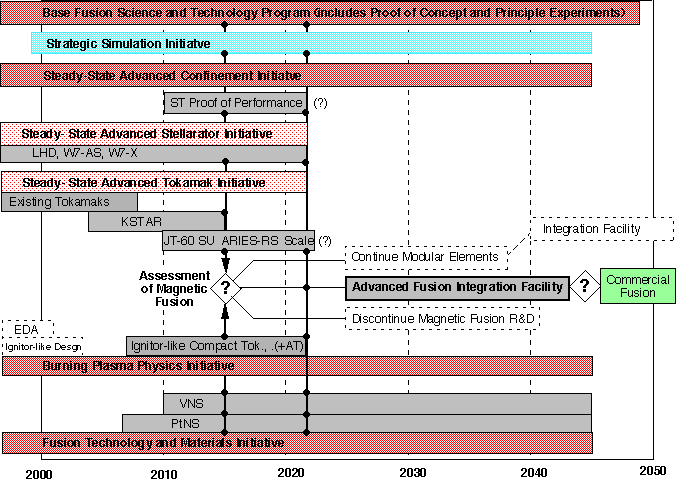
There are currently no facilities in the world magnetic fusion program capable of the study of high-energy-gain, burning plasma issues. TFTR and JET carried out successful initial experiments with weakly burning D-T plasmas that were limited in plasma duration in 1993-97. JET is scheduled to carry out another series of weakly burning D-T experiments near the end of 2002. The TFTR and JET experiments have not only produced D-T fusion plasmas with Lawson parameters (nitETi) within a factor of 10 of that required for ignition but most importantly confirmed that D-T experiments could be carried out safely in the laboratory. The magnetic fusion program is technically ready today to begin construction of a $1B scale Ignitor-like compact ignition tokamak. The major thrust of the proposed Modular Pathway is to build a burning plasma facility at the earliest possible time as recommended by the Grunder FESAC Panel. The objective for the burning plasma initiative is to achieve, explore, understand and optimize strongly burning plasmas in a toroidal magnetic configuration. An analysis using the present tokamak data base indicates that a compact tokamak configuration would achieve the desired burning D-T plasma performance (Q 3 10) for pulse duration (>> energy confinement time and ~ plasma current redistribution time) needed to satisfy the burning plasma physics objectives. An important characteristic of the compact tokamak is that ignition can be achieved in a physical size much smaller than the final power plant such as ARIES-RS. Therefore, the incremental construction cost of this facility might be minimized to ~ 2$1B with construction taking ~7 - 8 years. The generic toroidal burning plasma physics information from this initiative would provide a foundation for understanding burning plasmas in the advanced tokamak, advanced stellarator and spherical torus configurations.
The Strategic Simulation Initiative (SSI) is a key element of the Modular Strategy. First, the SSI will be a powerful capability in developing the fundamental physics understanding of the Steady-State Advanced Confinement Initiative (Advanced Tokamaks, Advanced Stellarators and Spherical Tori) and in the Burning Plasma Initiative which uses the pulsed tokamak to cost-effectively access burning plasma conditions. The major advantage of the SSI will be to intellectually integrate the fundamental burning plasma physics understanding from the Burning Plasma Initiative and the fundamental physics understanding from the Steady-State Advanced Magnetic Confinement Initiative that will allow the development of an optimized step forward in magnetic fusion, the Advanced Fusion Integration Facility. The SSI is expected, in fact, to play a key role in all three pathways discussed in this report.
The Fusion Technology and Materials Initiative would focus on the critical task of developing and testing advanced materials that would lead to an attractive fusion power plant. An essential capability needed in this area is an intense neutron source capable of irradiating candidate materials to power plant scale fluences. A conceptual design for the Point Neutron Source (PtNS) has been developed through an IAEA collaboration and is estimated to cost ~$0.8B. A volume neutron source would test larger size (~10m2) sub-components to prior to reactor scale integration and is expected to have a construction cost in the range of $1-2B. Such facilities will be needed in the other two pathways described in this report.
Because the costs of the various facilities all exceed the amount that would be available in the US fusion budget under the present constraints, international collaboration would be required to implement this modular strategy.
The Three Major Fusion Initiatives would be carried forward to a Magnetic Fusion Assessment Check point in ~2015 which would review the status of magnetic fusion and decide whether to (1) proceed forward to an Advanced Fusion Integration Facility, (2) extend the Modular phase or (3) move to another innovative confinement concept.
3.2 Rationale for the Modular Program Strategy
3.2.1 Hardware Integration Strategy
The fusion R&D program has used the modular approach for the first decades of research and has understood that these program modules would be integrated near the final stages of fusion development. However, fusion is still in the research phase at this time. Significant progress has been made in producing reactor plasma conditions for short durations in the laboratory that gives encouragement that a solution is possible, but the knowledge base does not exist at the present time to build an attractive fusion power system.
The most efficient approach to pursue fusion R&D objectives at this time is to focus on critical issues in each sub-area, and to develop the knowledge in each sub-area to near that needed for integration at the energy production scale. The advantages of this approach are:
• reduces cost and time for individual steps, and
• allows innovation to be incorporated earlier.
Fusion has a particular challenge at this time to not only demonstrate the scientific and technological feasibility of magnetic fusion, but to also develop economically and environmentally attractive fusion power systems. Keys to this are advanced magnetic confinement systems with high fusion gain, high power density and high duty cycle preferably steady-state plasmas, the corresponding enabling technology and the necessary nuclear technologies with attractive environmental characteristics such as low activation and the ability to withstand the neutron fluence. The Modular Program Pathway has focused program elements or initiatives that are targeted on addressing these issues.
Two major issues for toroidal magnetic confinement are: (1) the scaling of confinement in alpha heated plasmas and (2) the effect of dominant alpha heating on the magnetic configuration, plasma energy confinement and potential alpha driven instabilities. The basic physics of these processes has been studied using neutral beams or radio-frequency waves to simulate the effects of alpha heating. Information on the scaling of confinement during strong alpha heating and the magnetic configuration parameters required for ignition is central to developing magnetic fusion. In addition, alpha heating depends on the local plasma parameters, which in turn depend on local plasma confinement and alpha heating. Understanding and controlling this complicated non-linear feedback loop is a critical issue for all advanced toroidal magnetic systems - advanced tokamak, spherical torus and advanced stellarator, and experiments with high gain plasmas are needed. The basic strategy for the Burning Plasma Physics Initiative is to continue to use the pulsed tokamak as a research tool to cost effectively access strongly burning plasmas and to address these fundamental burning plasma issues for all toroidal configurations.
Plasma heating, current drive, fueling, particle and power exhaust are also generic and common plasma technology issues for the advanced tokamak, spherical torus and advanced stellarator. Tritium retention and handling, remote maintenance and blanket technology are closely related nuclear technologies for all toroidal systems as well. Detailed systems studies of potential power plants based on the advanced tokamak, spherical torus and modular stellarator confirms that these toroidal systems are almost identical in their capital cost and cost of electricity (COE), and are very similar in other characteristics such as plasma volume and magnet energy as shown in Table I.
Table I. System studies of advanced tokamak, spherical torus and stellarator power plants.
Advanced Reactor Innovation Evaluation Study (ARIES)
|
(A = 1.6) |
|
|
|
| Power (Thermal), GW |
|
|
|
| Power (Net Elec), GW |
|
|
|
| Capital Cost, $B(1992$) |
|
|
|
| COE, mil/kWh (1992$) |
|
|
|
| Plasma Volume (m3) |
|
|
|
| Magnetic Energy, GJ |
|
|
|
| Plasma Current, MA |
|
|
|
3.3 Technical Contributions of the Modular Plan
3.3.1 Burning Plasma Physics Initiative
The fusion program needs the capability to extend the frontiers of fusion plasma physics that will enable discoveries in previously unexplored parameter space that have the possibility to lead to more attractive fusion regimes. The coupling of advanced toroidal physics with strongly alpha-heated plasmas is a key issue for the development of attractive toroidal magnetic reactors whether they are classified as advanced tokamaks, spherical tori advanced stellarators or reversed field pinches. The achievement of an ignited (Q 3 10) plasma will allow these scientific objectives to be achieved.
Objectives for the Burning Plasma Physics Initiative
• Control of high Q plasmas through modification of plasma profiles and external sources.
• Determination of the effects of fast alpha particles on plasma stability.
• Sustainment of high Q plasma - high power density exhaust of plasma particles and energy and alpha ash exhaust, some evaluation of alpha heating on bootstrap current profiles.
• Exploration of high Q burning plasma physics
in some advanced configurations/operating modes that have the potential
to lead to attractive fusion applications.
Phase I : Demonstrate, control and optimize strongly burning D-T plasmas (Q 3 10) for an extended duration. Assume base line ITER performance [ HH ~ 0.85*ITER 93-H(Elm-free), bN 2 2.5] in line with the present conventional tokamak data base.
Phase II: Demonstrate, control and optimize enhanced performance (e.g. gyroBohm) or advanced physics modes (e.g.,TPX/ARIES-RS) in strongly burning plasmas for an extended duration.
Phase III: Demonstrate controlled ignition (Q
3 10) and extended burn.
Physics Requirements for an Advanced Burning Plasma Experiment
The physics of a burning plasma can be explored if the parameters listed below are attained.
Burn time 3 10 tas - alpha heating, fast alpha effects ( e.g., TAE)
3 10 tE - pressure profile evolution due to alpha heating
3 3 tHe - helium ash accumulation
3 3 tcr(tcurrent
redistribution )
- evolution of bootstrap current
Possible Facilities for the Burning Plasma Initiative
A normal conductor burning plasma device has the advantage of providing high magnetic fields and plasma currents at a reduced size and cost relative to a superconducting system since a neutron shield is not require to protect the toroidal and poloidal coils thereby allowing the major radius to be reduced. A significant cost savings is also realized by using copper alloys and inertially cooled cryogenic technologies. The copper coil systems could also allow for stronger and more flexible plasma shaping which is desirable for advanced burning plasma experiments.
A number of copper coil burning plasma devices have been studied including Ignitor (1978-98), CIT (1986-89), BPX(1990-91), BPX-AT(1991-1998) which are precooled to cryogenic temperatures prior to the pulse, HLT(1990) which was actively cooled with LN and PCAST(1996) which was actively cooled with water. The general physical parameters of these devices are summarized and compared with ARIES-RS and ITER-EDA in the following table. Projections of D-T performance for these facilities using the same methodology as ITER RC is given in a later section.
Table II. Parameters of Burning Plasma Facilities
|
(m) |
(m) |
|
|
(T) |
(GJ) |
(MA) |
(s) |
(MW) |
($B) |
|
| TFTR |
|
|
|
|
|
|
|
|
|
|
| JET |
|
|
|
|
|
|
|
|
|
|
| Ignitor |
|
|
|
|
|
|
|
|
|
|
| Spherical Torus |
|
|
|
|
|
|
|
|
|
|
| BPX-AT |
|
|
|
|
|
|
|
|
|
|
| CIT |
|
|
|
|
|
|
|
|
|
|
| BPX |
|
|
|
|
|
|
|
|
|
|
| Gyro-Bohm JET |
|
|
|
|
|
|
|
|
||
| HLT |
|
|
|
|
|
|
|
|
|
|
| PCAST |
|
|
|
|
|
|
|
|
|
|
| ARIES-RS |
|
|
|
|
|
|
|
|
|
|
| ITER-EDA |
|
|
|
|
|
|
|
|
|
|
Estimated Fusion Performance of Normal Conductor Burning Plasma Experiments
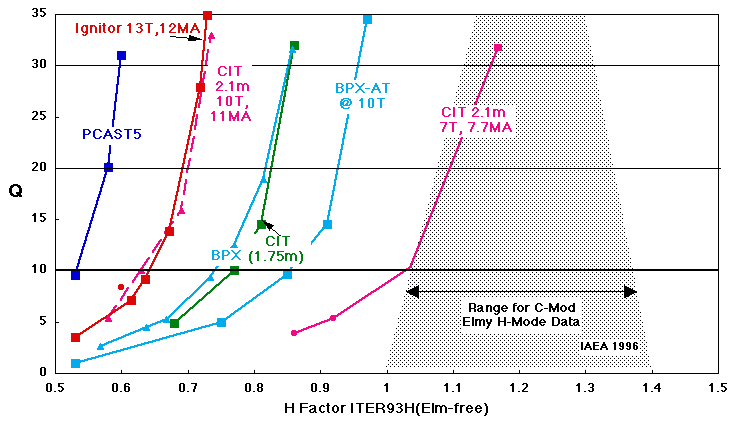
The performance of PCAST, Ignitor, CIT, BPX and BPX-AT was estimated using a zero-D model assuming ITER-93H (ELM-free) confinement scaling with alpha heating and fuel depletion due to alpha ash accumulation calculated self-consistently. The plasma profiles were taken to be the same with a flat density profile (an = 0.1) and modestly peaked temperature profile (aT = 1). The impurity levels were taken to be 3% Be and the alpha ash was assumed to have a confinement time tHe= 5 tE resulting in Zeff Å 1.5. These assumptions are the same as the modeling assumptions made for the Reduced Cost ITER with the exception that ITER-RC assumes tHe= 10 tE for the baseline performance mode and tHe= 5 tE for advanced performance mode. For BPX-AT at Q = 10 increasing tHe from 5 to 10 tE increases the required H93-Elmfree H factor by 10%. Some of these calculations are summarized in Fig. 3.2 below.
Compact Ignition Tokamaks
The compact tokamaks (e.g., Ignitor and BPX-AT) first advocated by Coppi with higher magnetic field and higher plasma densities have additional advantages with respect to beta limits, operating density limits, impurities and fast alpha particle limits and are well suited for studying burning plasma physics during the time scales of interest. Recent results from tokamak confinement experiments, in particular Alcator C-Mod, confirm the high field compact ignition tokamak design assumptions with regard to confinement, ICRF heating, power handling and impurity control. Alcator C-Mod with ELMing H-modes tends to operate with 20-30% higher confinement relative to ITER93H scaling than larger lower field lower density tokamaks and provides confidence that Ignitor-like compact tokamaks would achieve the performance required to achieve the burning plasma objectives.
Detailed engineering designs have been carried out for copper alloy coils cooled to cryogenic temperatures and significant operating experience has been obtained. Ignitor is designed to have copper alloy coils that are precooled to 30 °K with liquid hydrogen while BPX-AT, CIT, BPX designs have copper alloy coils that are precooled by LN to 77 °K. The pulse length is determined by the adiabatic temperature rise of the conductor/structure thermal mass during the pulse. A small reduction in the peak coil current allows the pulse length to be increased dramatically for the coil/cooling configuration. For example, reduction of the magnetic field in BPX-AT from 10 T to 7 T allows the magnetic field flat top to be extended from 12 s to 56 s. This feature of Ignitor-like compact tokamaks can be used to advantage for studying advanced tokamak regimes where improved confinement and b allow the plasma current and magnetic field to be reduced as shown in the example below for BPX-AT (Fig. 3.3). In order to exploit this capability the initial design would need to incorporate or allow upgrades for active cooling of internal divertor components (as in BPX-AT) and techniques to pump helium ash during the pulse.
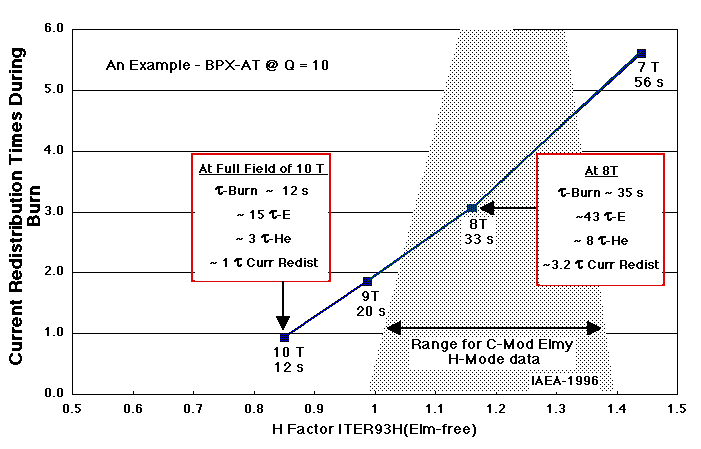
Alpha Physics Considerations for the Burning Plasma Physics Initiative
After alpha heating, the primary alpha physics issue concerns alpha-driven toroidal Alfvén eigen (TAE) mode instabilities which could cause the loss of energetic alpha particles before effective alpha heating had occurred. Ideally, the burning plasma experiment should be able to avoid these instabilities while achieving high Q and to then controllably approach the stability boundary to determine the physics constraints for future devices. The TAE instability occurs when the alpha particle speed, Va, is 3 the Alfvén speed, VAlfvén, and (R/a)—ba exceeds a threshold that depends on details of the plasma and magnetic profile (e.g., b and shear). It can be shown that ba depends on bTe5/2 and the temperature can be varied by adjusting the plasma density. The curves in Fig. 3.4 are density scans for 0-D calculations where Q was held constant (by adjusting H) while maintaining constant helium ash and impurity fractions. The Ignitor-like compact tokamaks can scan the same general range of TAE instability parameters space as the ITER-EDA and PCAST devices.
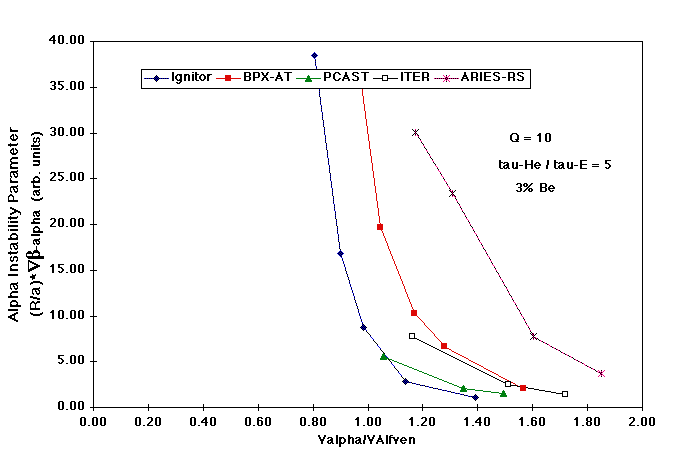
Fig. 3.4. Comparison of parameters
that determine the instability boundary for alpha-driven toroidal Alfvén
eigen (TAE) modes.
A moderate size normal conductor tokamak (R = 3m, B ~ 6 T, Ip ~ 10 MA) experiment based on extrapolation of DIII-D/JET gyro-Bohm scaling experiments has been proposed. This physics mode is not considered to be an advanced tokamak mode, such as the reversed shear mode, and therefore enhanced performance is achieved without the need for strong active plasma profile control. The advantage is a more robust (i.e., reliable) plasma configuration with potentially fewer plasma disruptions. A concept study for a similar size tokamak has been carried out for a high-performance long-pulse tokamak (HLT) with parameters as shown in Table II. The HLT design, which is also inertially cooled, increases its adiabatic pulse length by using the thermal mass of an external liquid nitrogen reservoir which is initially subcooled to 63.5 °K prior to each pulse. The toroidal field coil and central solenoid are actively cooled during the pulse by circulating the LN through the cooling channels. This design allows the pulse length to be arbitrarily extended by enlarging the liquid nitrogen reservoir, but reduces the maximum attainable magnetic field to accommodate the cooling channels. Active LN cooling of this type is being evaluated as a possibility for extending the pulse length on compact tokamaks as well as moderate scale tokamaks. Further work is needed in a multiple machine program to test the gyro-Bohm scaling and to investigate pedestal scaling especially at higher bN.
1. The compact high field tokamak utilizing cryogenic normal conductors is a potential pathway to access Q 3 10 conditions and address burning plasma physics with a facility costing 2$1B. In addition, evaluation of burning plasma physics in an advanced configuration for up to several skin times is possible.
2. Technological issues associated with the longer pulses (e.g. helium pumping and other internal components) in a compact high field tokamak need more detailed analysis and should be updated to include recent results.
3. Intermediate size (JET-scale) normal conductor tokamaks offer interesting possibilities for burning plasma physics research with costs in the ~$1.5B range.
4. Larger burning plasma tokamaks utilizing superconducting
coils while somewhat more capable have costs in the several $B range.
Objectives of the Steady-state Advanced Confinement Physics Initiative
The development, exploration and detailed understanding of high confinement, high fusion power density and high duty-cycle (steady-state) plasmas is needed for the development of economically and environmentally attractive applications of fusion power. This initiative includes subprograms on steady-state advanced tokamaks, steady-state advanced stellarators and other Proof of Performance experiments that might emerge from the ongoing Base Fusion Science and Technology Program such as the Spherical Torus.
Steady-state Advanced Tokamak Program Initiative
Outstanding progress in exploring and understanding advanced plasma regimes for short pulse magnetically confined plasmas has been made by a number of specialized medium-sized and several large size pulsed tokamaks. The next frontier in the advanced tokamak configuration is to extend high performance advanced tokamak regimes to near steady-state conditions in fusion-relevant plasmas so the plasma physics (with the exception of actual alpha physics) of a magnetic fusion plasma can be understood and optimized. The strategy is to use H and D plasmas rather than D-T plasmas to increase experimental flexibility and to reduce costs associated with tritium handling and neutron activation that are present at burning plasma facilities.
The steady-state advanced tokamak program will be dedicated to the development of the scientific basis for a compact and continuously operating tokamak fusion reactor. It will explore techniques for optimizing steady-state plasma performance through active control of the current profile, the pressure profile, the radial electric field profile, transport barrier formation, of plasma-wall interactions, and by advanced plasma shaping. Key areas to be optimized are the averaged plasma pressure (or b) through wall stabilization, the plasma confinement through transport barriers, and the current drive efficiency. This will involve making efficient use of the self-driven bootstrap current to provide a substantial fraction of the total plasma current. The integration of optimized plasma performance and efficient continuous operation will be a key issue, as will be control of major plasma disruption. Advanced tokamak operation will be at reduced current levels compared to conventional tokamaks and this will reduce the impact of disruptions.
Requirements for the Next Step Steady-state Advanced Tokamak Initiative
The plasmas needed to resolve the steady-state advanced confinement issues should have physics phenomena similar to that projected for a fusion plasma. This requirement would be satisfied if the dimensionless plasma parameters r*, n* and b* are comparable to those in a strongly burning (e.g., Q > 10) D-T plasma. Kadomtsev (Nuclear Fusion 1975) has shown that plasmas can have the same r*, n* and b* if they have the same similarity parameter, Ba5/4. In addition, the pulse length must be sufficient to allow a thorough study and controlled modification of plasma current evolution in advanced tokamak modes (e.g., pulse length 3 10 tcr), and to allow the plasma wall/divertor interaction to come into equilibrium. Some aspects of alpha particle physics (e.g., TAE modes in reversed shear magnetic configurations) can be simulated using the injection of high power beams and RF power. The physics issues and criteria have been previously discussed in detail in the Tokamak Physics Experiment (TPX) conceptual design.(e.g., IAEA paper 1994)
In addition to having dimensionless physics parameters similar to those in a strongly burning plasma and having long pulses for current control and wall equilibration, there are several other physics issues for this initiative. An advanced flexible divertor configuration is required to study the interplay between edge conditions needed for enhanced confinement modes and the requirements for heat dispersal and limited recycling back to the main plasma. The poloidal field system and divertor configuration must allow a wide range of plasma shapes and plasma current profiles to be explored. In addition, detailed steady-state current profile control is needed, necessitating the requirement for multiple current drive systems. Plasma diagnostics are particularly important in this experiment, both for fundamental understanding and for active control.
Possible Facilities for the Steady-State Advanced Tokamak Initiative
During the next 5 years the existing tokamak facilities will be exploited to address the steady-state advanced tokamak issue over the parameter space available to those devices. A number of facilities could be upgraded to extend their capabilities in this program element. However, significant new facilities are needed in the world program to fully address this issue for an advanced tokamak reactor as exemplified by ARIES-RS. The possibilities that have been considered are listed in Table III. The parameters shown are the nominal full field parameters with the exception of Alcator C-Mod.
Table III. Parameters of Steady-State (long-pulse)
Advanced Confinement Tokamaks*
|
(m) |
(m) |
|
|
(T) |
ARIES-RS |
(MA) |
(s) |
(s) |
($B) |
|
| Alcator C-Mod (Cu) |
|
|
|
|
|
|
|
|
|
|
| DIII-D (Cu) |
|
|
|
|
|
|
|
|
|
|
| JET (Cu) |
|
|
|
|
|
|
|
|
|
|
| JT-60U (Cu) |
|
|
|
|
|
|
|
|
|
|
| Triam (S/C) |
|
|
|
|
|
|
|
|
|
|
| Tore Supra (S/C) |
|
|
|
|
|
|
|
|
|
|
| SST-1 (S/C) |
|
|
|
|
|
|
|
|
|
|
| KSTAR (S/C) |
|
|
|
|
|
|
|
|
|
|
| TPX (S/C) |
|
|
|
|
|
|
|
|
|
|
| JT-60SU (S/C) |
|
|
|
|
|
|
|
|
|
|
| ARIES-RS (S/C) |
|
|
|
|
|
|
|
|
|
|
| ITER-EDA (S/C) |
|
|
|
|
|
|
|
|
|
|
An important point to note in this regard is that JT-60 SU has almost the same dimensional as well as dimensionless parameters as ARIES-RS, and hence one would expect the costs (exclusive of D-T and nuclear technologies) to be comparable. If the requirement is to study advanced tokamak physics at ARIES-RS dimensionless parameters then the test plasma must have BR5/4 Å to ARIES, and since the rough cost scaling for both superconducting and copper machines is cost ~B0.87R1.85 (J. Schmidt), then the cost of the test plasma device will scale roughly as cost ~ (BR5/4)1.48/B0.61. A possible cost reduction could be realized by increasing the magnetic field and decreasing the major radius.
The non-burning steady-state advanced confinement experiments (e.g., JT-60 SU) would need extensive plasma heating power(~60 MW) to bring the reactor size plasmas to high temperature and flexible high power current drive systems. The high-performance long-pulse tokamaks would initially operate with hydrogen, and later transition to deuterium operation to minimize neutron activation of the structure near the plasma. KSTAR, TPX and JT-60 SU are designed with modest shielding between the plasma and the superconducting coils, and have incorporated low activation materials into the mechanical structure near the plasma.
Integration of the Burning Plasma and Steady-state Advanced Confinement Initiatives
The programs of the Advanced Burning Plasma experiment and the Steady-State Advanced Confinement initiatives would be coordinated and integrated programmatically. A comparison of plasma relevant parameters for possible devices in the two programs are shown in Table IV.
Table IV. Comparison of Potential Elements for
Advanced Burning Plasma and Steady-state advanced confinement for the Next
Step Modular Program.
|
(m) |
(m) |
(T) |
|
(MA) |
(s) |
(s) |
|
(MW) |
($B) |
|
| Ignitor (full B) |
|
|
|
|
|
|
|
|
|
|
| BPX-AT (full B) |
|
|
|
|
|
|
|
|
|
|
| BPX-AT ( 80%B) |
|
|
|
|
|
|
|
|
|
|
| PCAST |
|
|
|
|
|
|
|
|
|
|
| ARIES-RS |
|
|
|
|
|
|
|
|
|
|
| JT-60 SU |
|
|
|
|
|
|
|
|
|
|
| TPX |
|
|
|
|
|
|
|
|
||
| KSTAR |
|
|
|
|
|
|
|
|
3.3.3 Strategic Simulation Initiative
The Fusion Energy Sciences leg of the Strategic Simulation Initiative will provide additional capability to integrate these two initiatives, and to transfer the generic information from the tokamak initiatives to the advanced stellarator and spherical torus confinement initiatives. This Strategic Simulation Initiative will develop and employ advanced computational methods and multi-teraflop computing resources to greatly accelerate the development of a comprehensive simulation capability for magnetically confined fusion plasmas. The elements of the Simulation Initiative include both microscopic modeling of plasma turbulence that leads to anomalous energy transport and macroscopic modeling of global plasma instabilities that lead to plasma disruptions. By calibrating this simulation capability against both the burning plasma experiment and the steady-state advanced confinement experiment, we will gain the confidence needed to use this as a design integration capability for use in defining the optimum advanced magnetic configuration and in designing the next step integration experiment. To the extent that these devices allow additional direct integration of burning plasma physics and advanced tokamak physics, it will be possible to perform additional calibrations with this simulation capability to gain additional confidence in their projections to the next step.
3.3.4 Fusion Materials and Technology
Fusion Technologies
Technology and materials will be the eventual keys to the realization of fusion’s potential as an energy source. Achieving acceptable performance for a fusion power system in the areas of economics, safety and environmental acceptability, is critically dependent on performance of the blanket and divertor systems which are the primary heat recovery, plasma purification, and tritium breeding systems. A fundamental understanding of key materials and technology issues is required to develop a compatible combination of materials (breeder, coolant, and structure) for the blanket system. Key issues include chemical compatibility, neutronics, thermohydraulics and stress conditions in addition to the irradiation effects and tritium interactions . The development of blanket systems require integrated prototype module testing in a 14 MeV environment. Such testing could be conducted in the proposed Advanced Fusion Integration Facility, or in a smaller dedicated D-T test facility such as the Volume Neutron Source (VNS).
Materials
Design and performance of these key components rests in turn upon the properties and characteristics of the structural materials. Temperature limits imposed by the properties of materials are the major limitation in the quest for high thermal efficiency. The major in-vessel systems will have a finite lifetime and will require remote maintenance and replacement. Reliability and lifetime, which are primarily determined by the performance of materials, will have a significant impact on plant availability, a second major factor in the cost of energy equation. Mechanical properties of structural materials under conditions associated with off-normal events, radioactive isotope inventory, and release paths are key considerations in designing for safety. The initial levels of radioactivity of materials on removal from service and the rate of decay of the various radioactive isotopes, dictate acceptable storage and disposal methods and the possibility of recycle of materials, both being major considerations in the environmental acceptability of fusion. The development of low activation materials is a long-term endeavor and a critical issue on the path to fusion energy. Fission reactors are currently used for irradiation studies. However, a 14 MeV point neutron source (PtNS) will ultimately be needed to fully qualify materials for fusion reactor applications. Conceptual design of such a materials test facility is being pursued as part of an international collaboration.
Enabling Technologies
Technology also plays a vital role in the continued progress in fusion science. Exploitation of existing and planned experiments will depend on further advances in certain technologies, particularly those related to manipulation and control of the plasma, extension to longer pulses, and operation in a radiation environment. Within the context of the fusion program’s goals to develop a low-cost, next-step device and the knowledge base for a more attractive fusion power source, the likely reduction in the size and complexity envisioned to accomplish these objectives will require improved technologies to handle higher heat loads, produce lower cost magnet designs, develop safe and efficient tritium processing systems and develop more efficient and flexible heating, current drive, and fueling systems.
Synergy Between the Inertial Fusion Energy (IFE) and Magnetic Fusion Energy (MFE) Programs
The ICF community is currently developing an integrated plan for the development of all aspects of IFE including drivers, targets, target fabrication and injection, chambers, and final optical systems that will survive in a fusion environment. There are three driver options: heavy ion accelerators, diode-pumped solid state lasers and krypton fluoride lasers. The proposed plan calls for the construction of an Integrated Research Experiment based on one of these drivers beginning in FY 2003. The potential exists for synergy between magnetic and inertial fusion energy (IFE) technology development. Several of the technologies under development by the MFE program are applicable to IFE such as:
Major Technology Facilities
Fusion materials must operate in a very demanding environment which includes various combinations of high temperatures, chemical interactions, time dependent thermal and mechanical loads, and intense 14 MeV neutron fluxes. Neutron irradiation is a particularly important issue, due both to its effects on physical and mechanical properties as well as the production of radioactive materials, and is the most difficult to investigate with currently available facilities.
At present fission reactors are the primary means to investigate the effects of irradiation on fusion materials. In addition there are specialized studies which can be done in ion beams (REF). However the response of materials to these various radiation fields can be quite different from that due to a fusion neutron spectrum. Various techniques have been used to more nearly reproduce the fusion environment, but a 14MeV neutron source will ultimately be needed to develop and qualify fusion materials. The source must reproduce the fusion spectrum, particularly in terms of the ratio of transmutation products to atomic displacements, and must have flux and fluence capabilities sufficient to allow accelerated testing to fluences up to end-of-lifetime. The international community has proposed as a Point Neutron Source an accelerator facility based on the D-Li interaction (IFMIF). The characteristics of the IFMIF are summarized in Table V. The Final Report of the Conceptual Design Activity estimates the cost of the facility to be ~0.8B$. Development and qualification of structural materials in such a device would be required before embarking on a high-fluence fusion-based system.
Table V. Point Neutron Source Parameters
| Neutron Flux Volume | > 1 MW /m2 >6.0 liter |
| > 5 MW /m2 0.4 liter | |
| > 20 MW /m2 0.1 liter | |
| Particle |
|
| Beam Current |
|
| Beam Energy |
|
| Beam spot |
|
| Duty Factor |
|
| Plant Factor |
|
The technologies needed to build a source like IFMIF are essentially in hand, and share much in common with high-power spallation sources, and the APT program. The primary uncertainties relate to the high reliability and availability requirements.
Engineering testing of nuclear components
The overall goal of the fusion technologies area is to develop a blanket system that meets the performance requirements of tritium self-sufficiency and efficient energy recovery, and at the same time achieves the desired level of safety and environmental attractiveness. While much work can be done without a high flux neutron environment, development and testing of fusion blankets and other nuclear components will eventually require a large volume plasma-based neutron source. The required technical features, summarized in Table VI, are taken from the IEA Study Summary which describes requirements for testing in fusion facilities, with emphasis on testing needs to construct a DEMO blanket.
Table VI. Fusion Nuclear Technologies Testing
Requirements
| Neutron Wall Load, MW/m2 |
|
| Plasma Mode of Operation |
|
| Minimum Continuous Operating Time, Weeks |
|
| Neutron Fluence (MW•y/m2) at Test Module | |
| Stage I: Initial Fusion "Break-in" |
|
| Stage II: Concept Performance Verification |
|
| Stage III: Component Engineering
Development and
Reliability Growth |
|
| Total Neutron Fluence for Test Device, MW•y /m2 |
|
| Total Test Area, m2 |
|
Fusion nuclear systems could be tested in any sufficiently sized facility, such as the Advanced Fusion Integration Facility, to demonstrate performance and reliability and activation features. However, the risk and cost of such tests are dependent on the cost and scale of the facility, leading to the idea of smaller options tailored to the testing task. A number of design studies have been performed that address the concept of VNS-like facilities, which are typically highly driven devices with Q ~ 1-2, and water cooled magnets. Examples include the Steady Burn Experiment work at MIT, the Spherical Torus concept at ORNL, the Small Fusion Development Plant at ORNL and two Small Business Innovation Research Projects focusing on Spherical and Conventional Tokamak confinement. A related but differently scoped facility, called a Pilot Plant, was pursued in 1988/89. These device concepts generally are small (e.g., R~2 meters or less), low power (e.g., 100 MW), normally conducting, jointed magnet tokamaks where the designs emphasize maximum access to the fusion core. Costs have been estimated in the 1-2B$ range. While the plasma performance required is less than that for a high-gain burning plasma facility, significant technology and materials development would be needed before embarking on this step.
3.4. Pathway Implications for the Modular Plan Option
The elements of a Road Map for magnetic fusion based on the modular approach are shown in Fig. 3.1. The burning plasma (BP), steady-state (SS) and nuclear technology mission elements of ITER are separated and addressed by specialized focused modular initiatives. The modular initiatives have greater flexibility to explore and exploit innovations to improve the attractiveness of magnetic fusion. For example, the burning plasma physics element can begin studies of more conventional regimes and then incorporate advanced tokamak physics into the later phases at lower cost. In addition, the steady-state non-burning plasma element is relieved of nuclear technology constraints and has much more flexibility to pursue experiments dedicated to developing innovative advanced tokamak concepts. This pathway also allows the alternate magnetic configurations to be evaluated at the Proof of Performance level before the specifications of the Advanced Fusion Integration Facility are determined.
While both the steady-state advanced tokamak and the burning plasma physics elements will develop significant enabling technologies, this plan explicitly calls for facilities dedicated to the development of fusion technologies and materials. The need for a VNS has been identified by several studies (Finesse, IEA) which called for the capability to test components with ~10m2 exposed to neutron fluxes of ~2 MWm-2 and fluences up to 6 MWam-2. In the modular plan, the focus is toward integrating advanced plasma physics, nuclear technology and advanced materials in an Advanced Fusion Integration Facility thereby allowing time for materials to be tested in the PtNS at high fluence.
The mission for facilities that follow the next stage of fusion R&D is a significant issue. The facility following the Next Steps is identified in Fig. 3.1 as a Advanced Fusion Integration Facility which would integrate and demonstrate all technologies and operating scenarios required for an attractive fusion power plant, and would therefore provide the scientific and technological foundation for a commercial fusion power plant. It is anticipated that the Advanced Fusion Integration Facility, which could be more advanced than ITER-RC, would demonstrate the entire fuel cycle and perhaps the production of electricity. The following Commercial Prototype would in turn be somewhat more advanced than the DEMO in the ITER-RC strategy and would have the important mission of demonstrating the high reliability needed for a commercial fusion power plant.
3.5 Advantages and Concerns for the Modular Program Pathway
The Modular Program Pathway follows from the viewpoint that magnetic fusion is still a research program and is not yet ready for a development step at the scale of a fusion power plant. The advantages of the Modular Program Pathway described in Section 3.1 include:
• The critical magnetic fusion issues are naturally modular and are maturing on different time scales. The Modular Pathway allows programs and facilities to be optimized with focus on specific technical issues and to have different time scales for resolution. The steps are more appropriate to our current level of knowledge than the "single step to DEMO" pathway.
• The Modular Pathway allows greater flexibility to explore and accommodate innovations and optimization of individual elements prior to a large scale integration facility. The Advanced Fusion Integration Facility (AFIT) would have more attractive features and less technical risk than the single step approach. Additionally, should the AFIT be designed to produce electric power, it could be considered a DEMO.
• The technical basis exists now to proceed with the burning plasma, advanced tokamak and materials development initiatives described. The Modular pathway allows for early investigation and resolution of burning plasma physics, steady-state advanced confinement physics and fusion materials and technology issues.
• The "advanced" tokamak is a very cost effective research tool for advancing generic toroidal plasma physics (enhanced performance, steady-state and burning plasma physics) and enabling technology that will benefit other innovative toroidal magnetic concepts that are being developed in the Steady-State Advanced Confinement Initiative.
• The Modular Pathway has multiple less-costly
facilities which substantially reduces the technical risk associated with
a single facility. Multiple facilities also offer the flexibility of multiple
international locations, and allow financial commitments to be made in
smaller amounts and phased over time.
• The Modular Pathway is a departure from the present international plan and is presently inconsistent with the national fusion strategies of our ITER partners. An explicit part of the European and Japanese national fusion plans, at this moment, is the concept of a single step to DEMO from JET and JT-60U.
• Some design solutions and technologies developed for copper magnet ignition experiments and D-D steady-state experiments may not extrapolate to an integrated facility.
• The Modular Pathway has "two steps" to a DEMO,
rather than the "one step" to a DEMO in the ITER-RC Pathway. Thus, the
cost and time of getting to the DEMO stage in the Modular Pathway will
both be larger than the corresponding numbers for the ITER-RC Pathway,
albeit the design basis for the DEMO will be superior in the Modular Pathway
with separate physics and technology facilities followed by an Advanced
Integrating Facility.
2. Carry out a detailed assessment/review of the physics, engineering issues, and costs for Ignitor-like compact tokamak burning plasma devices. Engage/inform the U. S. fusion community during this assessment.
3. Hold an workshop with interested international participants on Burning Plasma Physics and Engineering Issues of compact tokamaks. There needs to be an assessment of Ignitor and similar compact tokamaks to evaluate what fraction of the goals of a burning experiment they will meet and how Ignitor-like compact ignition tokamaks fit into the longer range magnetic fusion program. This assessment should include a comparison to other burning plasma experiments such as BPX, the most similar design but a larger device with a divertor.
4. Determine the physics requirements for the steady-state advanced confinement initiative.
5. Carry out a detailed technical assessment/review of the physics and engineering issues for the steady-state advanced confinement element including an assessment of the relative capabilities of existing facilities, facilities now under construction and possible new facilities. Engage/inform the U. S. fusion community during this assessment.
6. Define the role and technical requirements
for engineering testing of nuclear components in each of the three pathways.
4.0 Enhanced Concept Innovation Pathway
4.1 Pathway Overview
The previous two pathways focused on the tokamak next step, whether a single large facility integrating physics and technology in a DT device, or two facilities addressing separately burning plasma physics and non-inductive operation at high confinement performance on long time scales. Neutron irradiation facilities are assumed to be likely supporting facilities. Both pathways consider the same program elements and their associated theory and technology. This pathway also contains these program elements, but focuses on advancing a diverse portfolio of fusion concepts to bring forward the more attractive options for development. It suggests criteria for advancing these concepts, including the advanced tokamak, through successive stages of development. These criteria include cost, reactor attractiveness, and science value. In applying them we also strive to create a "balanced portfolio" of approaches to fusion power. Several concepts are now being pursued in the base program so this pathway should be viewed as already underway.
This pathway explicitly recognizes that technical readiness alone is not a sufficient basis for investing in a next step, and that any step can only be considered in the light of all other potential decisions in the near time frame. It is further recognized that there may be good reasons for modifying the criteria in particular cases. These reasons might include the desire to use the step to advance critical science, or that international participation reduces the cost to the U.S. However, in these cases the degree to which the criteria are modified should be justified by the value one expects from the step. This path will likely delay the availability of a commercial fusion energy system because the alternate concepts are in an earlier stage of scientific development but the resulting product, however, may be superior.
We will use the development stages defined in Chapter 1 to illustrate this pathway [See, Figure 4.1]. The development stages begin with concept exploration, and continue through proof of principle then proof of performance before entering the fusion energy development. The last stage explicitly requires international collaboration according to recent policy adopted by OFES in carrying out its "restructured" fusion program, as discussed in Chapter 1. Options for this stage are the focus of the preceding two pathways.
Pathway 3 is to emphasize and even maximize the number of fusion concepts for exploration. Selection based on technical success tends naturally to allow fewer concepts to reach successively higher levels of development. The Tokamak, Stellarator, and Inertial Confinement Fusion using lasers are the most advanced at this time. Among the variants to these approaches, the Compact Stellarator, the steady state Advanced Tokamak, and the steady state Spherical Torus (or the very low aspect ratio tokamak) are currently less advanced. Further, a number of other concepts are being explored experimentally, some of which are poised for proof of principle experiments.
With regard to decisions to advance a concept, we would impose four criteria; project cost, power plant attractiveness, science value, and impact on the balance of the portfolio. A discussion of each of these follows, but the detail for these criteria should be clarified by broader debates. These criteria define Pathway 3 and differentiate it from the other two pathways described in this report.
Appropriate Cost
Costs are expected to increase for devices at successfully higher stages of development. Cost curves are therefore expected to rise to the maximum for the fusion power plant. This maximum can be taken as an acceptable cost projected for a commercial power plant at a typical power rating such as 1000 MW in electricity produced. The cost criterion for a intermediate stage would be reduced accordingly, and should be cast in a well-considered range. Cost should not be a hard and fast criterion, nor be far exceeded except for adequate reasons, such as a compelling science value that
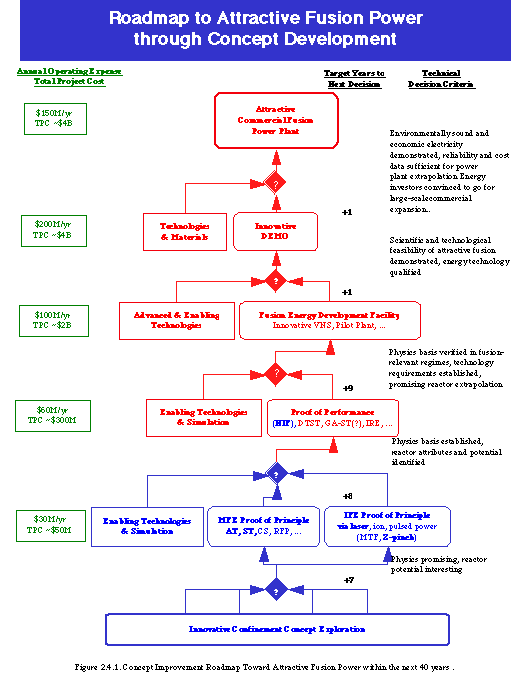
warrants additional investment. Such exceptions may be easier to justify at the lower rather than the higher stages of development.
Attractive Reactor
Attractive features projected to a power plant are of crucial importance. Application of this criterion depends on the development stage being proposed. Since these features are difficult to describe in detail during concept exploration, rough projections may be appropriate. For example, the FRC and the Spheromak possess an attractive feature by eliminating a large fraction of the magnets in contrast to the Tokamaks and the Stellarators where the magnets account for a large fraction of the cost and much of the complexity. The Spherical Torus and the Field Reversed Configuration project very high beta, an attractive feature for reducing the size and cost of the fusion core for a future power plant. As the concept progress to higher levels more of the reactor features and systems can be specified in increasing detail, rendering the criterion more stringent as well as easier to judge.
Science Value
Much of the magnetic fusion science base has been gained via the
tokamak research, but different and very interesting science is to be explored
and learned from other confinement approaches. For example, self-organized
plasmas such as the Reversed Field Pinch and the Spheromak utilize for
sustainment the plasma dynamos, a mechanism related to
the formation of solar coronal loops. Fundamental properties of magnetic
field reconnection in the Field Reversed Configuration are closely related
to the field-reversed sheath observed in the solar down-wind tail of the
magnetosphere. This criterion may thus play a large role, particularly
at the early phases of development. Even for the stage of fusion energy
development there is compelling incentive for a understanding
of the physics of fusion ignition and burn to warrant some relaxation of
the cost criterion. Evaluation of additional value (over that expected
from this stage) for additional cost (over the metric for that stage) should
be included in the decision.
Balanced Portfolio
Finally, it is the intent in this pathway to create and maintain a "balanced portfolio." We would define balance somewhat loosely as ensuring that each stage of development be populated with appropriate active options. We expect that a balanced portfolio include an expanded number of concepts at the exploration level, accompanied by diminishing numbers of concepts at progressively higher levels. Imagining a building block for each concept (including one for each major variant of the Tokamak, Stellarator, Inertial Fusion Energy, etc.), a vertical stack of blocks for each level would be roughly pyramidal. The balance needs to be managed through the decisions taken, since decision to build a particular device obligates the future and alters the potentially available funding for competing steps, as well as posit new advances that shed light on the relative merits of other possible steps. It implies that certain forward moves could be delayed in favor of others, even if technical readiness is demonstrated. We suggest that the criterion be applied more stringently at higher and more costly options of development, to avoid unwarranted negative impact on the balance of the portfolio and the negative image displayed for fusion energy by large and costly devices.
4.2 Rationale
Concept improvement has become a priority in the U.S. Fusion Energy Sciences Program. Efficient plasma production, containment, and fusion burn in modest size and simplified configuration characterize attractive fusion power. While the fusion research program has produced significant fusion power in the laboratory (in TFTR and JET), it must now innovate to produce the same efficiently, reliably and economically.
The U.S. does not perceive at the present time the need for rapid development of new energy sources. Thus, a compelling fusion concept will be required to kindle the necessary domestic interest and support, even at the reduced cost levels indicated here. Concept improvement in the U.S. fusion effort is therefore a necessity.
The Innovative Confinement Concepts (see Appendix 2.4-A) presently under consideration in the U.S. have a range of attributes for attractive fusion power and varying degrees of scientific and technological maturity. A broad portfolio for "Concept Exploration" enables reasonable balance of cost, risk, and benefit for an aggressive fusion energy sciences program. A balanced development in concept improvement would require that this portfolio contract as the concepts face the test for advancement.
4.3 Technical Contributions
Fusion confinement concepts naturally forms three groups: Magnetic Confinement (Pulsed Tokamak, Stellarator, Advanced Tokamak, Spherical Torus, Compact Stellarator, Reversed Field Pinch, Spheromak, Field Reversed Configuration, Electric Tokamak, Floating Multipole), Inertial Fusion (laser-driven and heavy-ion-driven Inertial Fusion Energy, Magnetized Target Fusion, Z-Pinch-driven Inertial Fusion Energy), and New Innovations (Inertial Electrostatic Confinement).
The first group of concepts relies on the magnetic field for containment. These concepts however span a wide range of different magnetic fusion plasma regimes, and utilize a plethora of techniques of plasma manipulation. This pathway addresses magnetic concepts other than the Pulsed Tokamak and the Stellarator. The second group relies on implosive compression of miniature frozen fuel capsules or small size magnetized plasmas via externally applied energy (photon pressure or mechanical force) to very high densities for extremely brief time scales (form Pico-seconds to ms). A variety of drivers, mechanism and technologies are used for this purpose. The third group covers those concepts that are different in nature from the first two groups.
These concepts possess widely differing attractive features and concerns that form the basis for potential contributions, in the light of burning plasma physics, steady state advanced physics, technology and integration. Advances in one concept usually contribute to the understanding and progress of other concepts in the same group.
4.3.1 Magnetic Fusion Energy
The attractiveness of a magnetic fusion concept depends on MHD stability (or absence of disruptions) at high beta, absence of microinstabilities that degrade confinement, and simplicity of sustained operation of the fusion power core. These, as examples of attractive physics features, suggest potential contributions by this group of concepts.
Advances in understanding of MHD beta limits in tokamaks
have given confidence of the high beta potential of the Spherical Torus.
Neutral beam injection heating, proven effective for the tokamaks,
has been used in a Spherical Torus to triple the Tokamak record toroidal
beta. The beneficial effects of velocity shear in suppressing microinstabilities
observed in the Tokamaks have provided a strong basis
for expecting improved confinement in other concepts of this group. These
potential improvements would reduce the unit fusion power while maintaining
high neutron flux intensity needed in a fusion energy development device.
Table 4.1 summarizes important potential contributions and concerns for
these concepts.
Table 4.1. Attractive Features and Concerns of Magnetic Confinement Concepts
| Concept | Development Stage |
|
| Advanced Tokamak | Proof of principle |
- Increased bootstrap current - Disruption - stability and control - Projected high cost for Energy Development |
| Spherical Torus | Proof of principle
(to begin in or before May 1999) |
- Improved potential for high confinement - Improved current drive, bootstrap current, and its profile - Increased dispersion of plasma exhaust - Possible interim non-electricity applications of neutron produced along path to fusion energy - Requires high plasma current with potentially high current drive recirculating power - Requires noninductive startup - Requires largely unprotected toroidal field central leg to ensure small size - Small normal conducting TF coils may project to large recirculating power - Disruption (possibly reduced or avoided via high safety factor or unobstructed vertical space) |
| Compact Stellarator | Concept exploration
(being reviewed for Proof of Principle test) |
- Disruption-free, but dependent on bootstrap current fraction - Reduced aspect ratio from standard stellarators - Trade-off between confinement and b uncertain at present |
| Reversed Field Pinch | Concept exploration
(being reviewed for Proof of Principle test) |
- No disruptions - Inexpensive current drive - Inductively driven - Magnetic turbulence-dominated transport — (reduced by edge current drive to approach (j/B) = constant) |
| Spheromak | Concept exploration |
- Potentially unstable to tilt instability - Magnetic turbulence-dominated transport — (reduced by edge current drive to approach (j/B) = constant) |
| Field Reversed Configuration | Concept exploration |
- Near unity b - Simple and inexpensive magnets - Finite orbit effects prevent ideal instabilities - Potentially high power density - Natural open divertor geometry - Global stability and sustainment for large device |
| Electric Tokamak | Concept exploration |
- Requires large drive for strong rotation - Global stability far beyond present understanding |
| Floating Multipole | Concept exploration |
- Better than unity b - Steady state; disruption-free - Potentially free of drift-wave turbulence and may obtain classical confinement - Low divertor heat load - Requires levitated superconducting ring |
4.3.2 Inertial Fusion Energy
While both magnetic and inertial fusion are at approximately
the same stage of scientific understanding, the scientific and technological
criteria by which these two distinct classes will be judged as power sources
are very different. The various concepts under Inertial Fusion Energy (IFE)
(see Table 4.2) offer routes to a fusion power plant
which are paradigm shifts from the Magnetic Fusion Energy (MFE) concepts.
Net fusion energy gain Q, the ratio of output fusion
energy to input drive energy, is a long-standing figure of merit for fusion
research. Both MFE and IFE have progressed significantly in to
approach systems for which gain exceeds unity, the so-called scientific
break-even. In pulses of one to ten seconds, large Tokamaks such as TFTR
and JET reported Q=0.3 and 0.9, respectively. The National Ignition Facility
(NIF) is under construction and preparing to test the gain of 10 in a single
pulse.
The term ignition is used differently by MFE and IFE. For MFE, it defines the plasma condition where alpha heating is adequate to sustain fusion grade plasmas without auxiliary heating (Q of infinity). For IFE, which is inherently pulsed, ignition refers to establishing a propagating fusion burn wave from a central hot spot through the compressed fuel, similar to a miniature explosion. Once ignition occurs, target gain is determined by the fraction of fuel burned before the fuel disassembles.
Table 4.2. Attractive Features and Concerns for Inertial Fusion Concepts
| Concept | Development Stage | Attractive Features and Concerns |
| Laser-driven | Proof-of-Performance (under construction) |
- Modularity offers attractive availability and load-growth expansion. - High leverage from complementary Defense-funded Inertial Confinement Fusion program (NIF etc.) — Ultimate driver costs must be ~$500M (direct) for attractive COE (@ 1GWe) - IFE targets must be mass-manufactured at low cost (~30¢/target) and be injected with acceptable tracking accuracy (<1mm) at rep-rates of several Hz - Final focusing optics must achieve desired target spot sizes - Requires exceptional high-cycle (~109) reliability of power components - Rapid cleansing of debris and residues from chamber at rep-rates of several Hz |
| Heavy-ion-driven | Concept Exploration |
- Higher driver efficiency than laser drive - Final-focusing optics better protected than laser drive - Other attractive features as for laser IFE - Other concerns similar to laser IFE |
| Z-Pinch-driven | Concept Exploration |
- Closely coupled, invasive electrode - Reactor extrapolation and designs undeveloped |
| Magnetic Target (compression) Fusion | Concept Exploration (being reviewed for Proof of Principle test) |
- Highly leverages DP investment in facilities, diagnostics, and implosion science - Advances CT science development at fusion-relevant conditions - Reactor advantages similar to IFE, improved possibility for liquid walls - Invasive magnetic coupling required in reaction chamber - Requires satisfying constraints on yield, rep-rate, and cost per target, similarly to laser drive and Z-Pinch drive |
4.3.3 New Innovations
Innovations that diverge qualitatively from the preceding two classes of fusion approaches should be encourage by this pathway. Inertial Electrostatic Confinement based on a modified form of Penning discharge exemplifies this classification.
| Concept | Development Stage | Attractive Features and Concerns |
| Inertial Electrostatic Confinement | Concept exploration |
- Confinement physics allows for very small-scale systems for development - Possible interim non-electricity applications of neutron produced along path to fusion energy - Net fusion energy gain at high surface to volume ratio: possible high mass power density with moderate wall loading - Requires very-high spherical convergence Grid-less systems - Requires precise control of electron distribution function |
4.4 Advantages and Concerns
The advantages of this strategy include:
- Broadened physics investigation and utilization of differing plasma regimes
- Widened areas for potential spin-offs to other fields of science
- Minimized risk of failures in fusion energy development
- Complementarity to foreign fusion programs, which is studying a more limited range of concepts
- Improved basis for realistic cost targets for funding
- Extensive utilization of existing facilities
- Encouragement for U.S. to gain a leadership
position in Innovative Confinement Concept fusion research
- Reduced near-term focus
- Increased risks for longer time and more cost to develop practical fusion energy
- Reduced compatibility with existing international
approach for ITER
Pathway 3 entails the consideration by the U.S. fusion community of the following actions:
- Plan for similar assessment for Compact Stellarator, Reversed Field Pinch, and Magnetic Target Fusion when and if Proof of Principle facilities approach the start of experimentation.
- Clarify in 1999 the U.S. fusion energy sciences
priorities and goals in the world fusion program.